
Pip & Nut’s Pippa Murray: ‘It takes time to build a brand in the mind of the consumer’
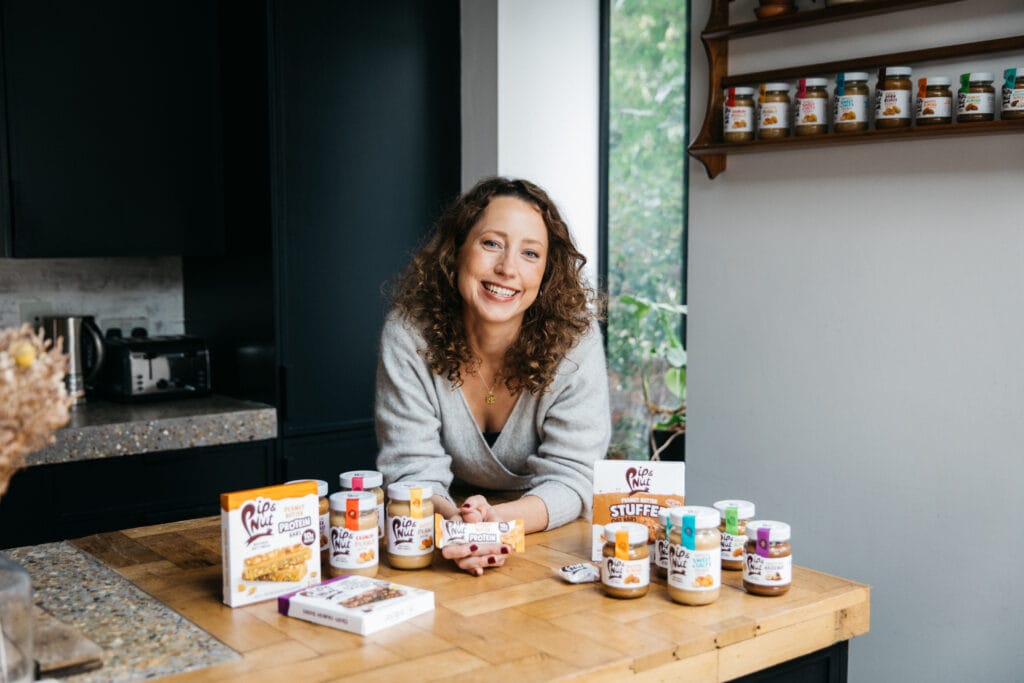
The Pip & Nut founder on starting with a blender, using niche products to win shelf space, setting limits on AI and taking the brand into protein bars.
Oil rises to the top of a jar of Pip & Nut. It needs stirring, something customers once complained about. Pippa Murray says those complaints have largely disappeared as shoppers now understand why natural nut butter separates. In fact, as consumers have become more aware of unpleasant additives and ingredients, some have become more suspicious of products that remain perfectly fixed in place.
“You get a jar of really processed, Americanised peanut butter and it’s so set, stabilised and congealed,” she says. “There’s still a bit of frustration with stirring, but you’d rather it was that way.”
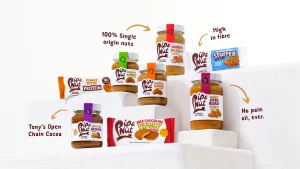
The separation comes from leaving out palm oil, a decision Murray made when she started developing Pip & Nut more than a decade ago. It created manufacturing difficulties, but it also gave the brand a clear position in a category that had seen little innovation.
From the home kitchen to Selfridges
Murray was in her mid-twenties, working outside food and drink and training for the Paris Marathon. Peanut butter was her preferred running fuel, but she was frustrated by the products available in supermarkets. Most contained palm oil, while natural alternatives and more unusual nut butters were hard to find.
“I remember thinking, I could totally do this better,” she says.
She bought a blender and began testing recipes in her kitchen. Rather than commission a large production run, she took small batches to London markets. This allowed her to experiment with cashew butters and different flavours while getting immediate feedback from customers.
“The leap from an idea to producing hundreds of thousands of units is a big one,” she says. “But it’s quite easy to get a blender, set up a market stall, do some rough-and-ready branding and get going.”
The products sold out regularly. Murray began speaking to manufacturers, developing the branding and working out how the business could supply national retailers.
“You do small steps over a period of time, then you get to the point where you’re almost so far in that you can’t not launch it.”
Pip & Nut formally launched in January 2015, with Selfridges as its first major customer. The initial range included smooth peanut butter, smooth almond butter and coconut almond butter.
Those less familiar products helped the business secure listings. Large competitors had little interest in categories they considered too small, giving Pip & Nut a route onto the shelf.
“When you’re starting something, you can exploit niches in order to get onto shelves,” Murray says. “Then you can broaden out”.
The company became the UK’s leading almond-butter brand before reaching the top of the wider nut-butter category, she says. Its early niche gave retailers a reason to stock it; the mainstream products followed once the business had established a track record.
The cost of a shorter ingredient list
Pip & Nut entered the market as shoppers were beginning to pay closer attention to food labels. Murray describes it as the rise of natural food, a conversation now increasingly focused on ultra-processed products.
Palm oil became the brand’s most obvious point of difference. It is an effective stabiliser, but Murray was concerned about its links to deforestation, habitat loss, monoculture and labour exploitation. She also questioned why it was needed in nut butter at all.
Her product-development rule is to keep ingredient lists short and use ingredients people might recognise from their own kitchens. Applying that rule at scale can be expensive.
Stabilisers and preservatives make texture, consistency and shelf life easier to control. Removing them places more pressure on the recipe and manufacturing process.
“When you make food products for retail, the more ingredients there are, the simpler it is,” Murray says.
The same challenge now applies to Pip & Nut’s cereal and snack bars. They take more work to produce because the company avoids many of the ingredients manufacturers usually use to improve stability and shelf life.
Making purpose operational
Pip & Nut became a certified B Corp in 2019 and gives 10 per cent of its profits to charity. Murray describes purpose as a “multiplier” because it influences recruitment, retention and staff motivation.
The company’s employee-engagement score is around 80 per cent. Internal surveys show that employees value working for a business with social and environmental commitments.
“People are motivated to do work that is meaningful,” Murray says. “They feel proud of the brand because it is more than selling stuff.”
Pip & Nut has also helped establish a JEDI collaboration, through which smaller B Corps share diversity and inclusion training, mentoring and recruitment knowledge.
Smaller businesses may lack the budget for extensive staff-development programmes, or their teams can also be too small to provide a broad range of perspectives and potential mentors. Pooling employees across several companies creates more options.
The mentoring programme is open to all staff. Murray says that informal career support often favours people with existing networks or the confidence to ask for it. The collaboration has run for three years and is continuing despite several larger companies reducing their diversity commitments.
“I don’t think it’s hard at all,” Murray says. “It’s about doing what’s right and what you think, for your own values, is the right thing to do.”

Setting limits on AI
Pip & Nut’s branding was designed to make its principles accessible rather than worthy. Its leaping squirrel communicates nature, energy and the product itself, while giving the company an asset that works across packaging and advertising.
The brand recently used artificial intelligence to animate the squirrel for a major campaign. Murray’s team placed limits on how the technology could be used.
The source photography featured real squirrels photographed in Norway. The products were filmed. Human creatives developed the idea and directors remained responsible for the execution.
“You can tell when something is AI for the sake of it,” Murray says. “It just feels like slop.”
The campaign took more than six months to produce and was no quicker than a conventional advert. Murray says that time was necessary to maintain the quality of the work.
“Whilst AI can speed you up in some regards, you have to make sure you slow down so that you don’t rush it.”

The next category
Pip & Nut is now applying its original approach to protein bars.
Murray had never eaten them herself because she found most products over-processed and unappealing.
The company’s bars use nuts for a significant share of their protein and combine them with peanut-butter caramel. At the time of the interview, snacks accounted for roughly a third of the business and were growing by almost 200 per cent that year. The company has also started expanding internationally, including a launch in Belgium.
Murray is wary of growth that depends on a short-lived sales spike. Consumer brands need sustained investment in products and marketing before they become familiar and trusted.
“It takes time to build a brand in the mind of the consumer,” she says. “You can’t rush that nuanced layering. It’s art and science. Consumers need time to trust and understand what you’re about.”
Sign up here to get the latest grocery and food news each morning