
Redefine Meat’s Edwin Bark on his uncompromising vision for the future of protein

FeaturesFMCGResearchSupermarkets

For Edwin Bark, the problem with much of the plant-based category has never been ambition. It’s been execution.

Too many brands, he suggests, rushed to market on the strength of hype, novelty and sustainability messaging, only to forget the one thing that really matters when a product lands on a dinner plate is whether people actually want to eat it again.

That belief sits at the heart of Redefine Meat, the food-tech business aiming to drag meat alternatives out of their worthy, often underwhelming phase and into something far more commercially powerful, a category capable of tempting committed carnivores.

“We need to bring the carnivores into our world not by saying, ‘Stop eating meat,’ but actually by inviting them to try and experience a very good piece of meat that is no longer a compromise,” Bark says.

The company, founded in 2018, has built its name on premium plant-based products engineered to replicate the flavour, texture, scent and cooking performance of animal meat. Its hero products are whole-muscle cuts, designed to do something the category has often struggled with. That is recreating the sensory complexity of a proper steak.

According to Bark, the company’s starting point wasn’t the vegan or vegetarian shopper, but the meat lover.

“What sets us apart from the competition is that we are very meaty. We’re obsessed by meat,” he says. “We have meat scientists working in our R&D team that analyse, on a molecular level, the composition of meat, and what we do is try to find plant-based equivalent molecules to the ones found in animal meat.”

It’s exactly the sort of language that makes Redefine Meat stand out in a market that has often leaned heavily on ethics, greenery and clean-label cues. Bark is clear that, for all the moral and environmental urgency surrounding the food system, consumers are rarely won over by guilt alone. They are won over by habit, pleasure, familiarity and trust.

That’s why the business has gone deliberately in a different direction, from its branding to its product development. “Our brand language is also very premium-meat in look and feel,” he says.

“It’s black and red, and the product is really the hero. Most brands have prepared dishes on the pack. We really give the hero position to our product.”

That thinking extends to the entire architecture of the range. Bark describes it in blunt commercial terms. Some products exist to “play to participate”, while others are designed to “play to win”.

“Play to win is where we have a unique proposition, like our whole cuts,” he says. “Play to participate is the category entry points. Burger patties, mince and so on. Our steak, our whole-muscle cuts, that’s our hero.”

It’s also where Redefine Meat has done much of its brand-building work. While plenty of plant-based players have aimed to mimic burgers, nuggets and sausages, Redefine Meat set its sights higher, both technically and culturally.

If meat still carries premium associations, then steak remains one of the clearest examples of that status. Recreating it was always going to be difficult. That, Bark suggests, was precisely the point.

“When we started the company, we thought, what’s missing in this market? And what makes people crave meat? We concluded that it’s whole-muscle cuts. It’s steak,” he says.

“With our technology background, we said, by using additive manufacturing technology, we should be able to recreate a fully plant-based version of a steak. That became our hero technology.”

Bark is careful about how he describes that technology. Redefine Meat has often been associated with 3D printing, but he prefers a more industrial framing.

“The more precise descriptor is additive manufacturing,” he says. “When you say printing, people think it’s really coming out of nozzles. At the very beginning of our technology development, that was indeed the case. We built what we called the Angus printer. But that specific technology was not scalable.”

From there, the business evolved the concept into something commercially viable. A production line capable of layering plant-based ingredients in a way that mimics the fibrous complexity of meat. It’s this combination of food science and process engineering that Bark sees as Redefine Meat’s real moat.

“We are the first, and I think the only ones, to be able to produce that at scale and also efficiently,” he says. “We have an industrial line of layered production that allows us to mimic the very complex texture of meat.”

That technical confidence is matched by a consumer-facing realism. Bark knows all too well that the category’s growth story has cooled in recent years. Plant-based meat, after a period of explosive momentum, has stalled. Brands have collapsed. Retailers have rationalised ranges. Investors have become more cautious. The initial euphoria has worn off.

But Bark sees that slowdown not as a sign of failure, but as a familiar phase in the adoption curve.

“What we are seeing is just the normal evolution of the S-curve of adoption,” he says. “People have discovered a lot of innovation, they’ve tried it, some are happy with it, some are disappointed. Those that are disappointed with the quality will stay away until there’s a new wave of innovation or an improvement in quality that makes them come back.”

In other words, the category hasn’t diminished. It’s simply reached the point where novelty is no longer enough.

“The truth is, it’s only the very beginning,” he says. “We’ve had the very end of the stagnation phase, and we’re now heading for a new wave of innovation. Not necessarily super disruptive. It’s very much focused on continuous improvement of existing products.”

Bark believes the next phase of growth will be won not by whichever brand can shout loudest, but by whichever brand can deliver the strongest repeat purchase. This is where he thinks Redefine Meat has pulled ahead.

“If the product is good, consumers will buy you,” he says. “We’re growing because we see continuous growth of our repeat purchase, meaning that consumers who try our products for the first time actually come back because they enjoy the product.”

That point is central to his critique of the wider category, and particularly to the race to the bottom that has defined some private-label plant-based ranges.

“Some retailers think you just have to make it cheap and people will buy it,” he says. “People buy it once because it’s cheap, but not a second time if it’s not tasty. The pressure to create very cheap protein means savings are made on the quality of the protein source or on the aromas.

“When you see a cheap burger for one and a half pounds, you can be sure it’s not tasty. It doesn’t exist.”

For Bark, then, the commercial logic is inseparable from the culinary one. Redefine Meat isn’t trying to undercut the market; it’s trying to out-perform it. The company isn’t the cheapest player in the space, he says, and nor does it want to be.

“We’re not the cheapest brand, actually,” he says. “We’re not super premium, but we’re on the above-average price level. Consumers are willing to pay for that because they enjoy the product.”

That confidence has also been built through foodservice, where Redefine Meat has arguably made some of its smartest moves. Before pushing into retail, the business focused on getting its products into restaurants, hotel groups and professional kitchens, using chefs as both validators and development partners.

“From day one, we started working with Michelin chefs,” Bark says.

“Michelin chefs are the most critical, as you can imagine. They would never risk their Michelin status by putting products on the menu that are not Michelin level. That’s why it’s really in our DNA to listen to chefs, but also to listen to consumers and understand their feedback.”

It’s a clever strategy. High-end foodservice gives the brand credibility, but it also gives it proof points. Bark says Redefine Meat now has around 7,000 foodservice locations where its products are on the menu.

When the company did move into retail, Bark says it didn’t want to “buy distribution” through brute-force spending. It wanted to earn it.

“We sit down with retailers that truly believe in our vision and share the ambition to drive this protein transition,” he says. “We create a coalition of the willing.”

That approach helps explain Redefine Meat’s partnership strategy in the UK, including its early work with Ocado and subsequent push into stores with Asda. Online, in particular, gave the brand a valuable testing ground.

“The beauty of working with an online retailer is that you get a lot of data, so you can constantly test and learn and improve your performance,” he says. “Once you have that collaboration where you can be totally transparent on how you do things and how you can improve them, there is a fantastic highway to growth.”

For all the confidence Bark has in the company’s model, he’s under no illusion about the headwinds facing the category. He speaks with visible frustration about regulatory efforts to limit the use of traditional meat terminology on plant-based products, dismissing the logic behind such measures as disconnected from consumer reality.

“I’ve sold literally millions of consumer packs. I never had any complaint from a consumer saying, ‘Hang on, your product is not made of animals, it’s plant-based, how can it be?’” he says. “There is no confusion.”

He sees that debate as a distraction from the real work required to shift diets at scale, particularly at a time when climate pressures, supply chain strain and rising livestock costs are likely to reshape meat consumption anyway.

“Consumers ultimately have to accept that meat becomes as exclusive as it was fifty years ago,” he says. “We used to consume meat only two or three times a week. We probably have to go back to that old normal.”

That is where Bark believes plant-based alternatives, if done well enough, have a major opening. Not as a fringe ethical purchase, nor as a synthetic substitute that consumers reluctantly tolerate, but as a mainstream, desirable protein choice.

“The issue is urgent,” he says. “We can’t wait another generation to achieve this shift. We have to be as attractive as possible to the largest possible group of consumers.”

That brings the story back to the same simple tension Redefine Meat appears determined to resolve: how to create products that satisfy the emotional and sensory pull of meat without inheriting the environmental cost of the livestock system.

Bark talks about this not as a branding exercise, but as a long-term engineering challenge.

“Ultimately, we will be able to beat the cow,” he says. “Because the cow is not innovating. We are.”

It’s a bold line, but then boldness is part of what makes Redefine Meat interesting. This isn’t a company asking for patience, pity or ideological buy-in. It’s asking to be judged on taste, texture, consistency and performance. The same standards traditional meat has long taken for granted.

And perhaps that is the most telling thing about Bark’s vision for the category. He doesn’t talk like a man trying to defend plant-based food from sceptics. He talks like someone who believes the next generation of meat is already being built and the future leaders of the category will be those who make consumers forget the compromise ever existed.

“People that tried poor products and were disappointed stay away for at least a year,” he says. “That’s why quality matters so much. Once consumers buy into ever-better products, the repeat purchase will be there.”

For Redefine Meat, that is the whole game. Not just getting on the plate, but getting invited back.

Sign up here to get the latest grocery and food news each morning

FeaturesFMCGResearchSupermarkets

Leave a Reply

Your email address will not be published. Required fields are marked *

Fill out this field
Fill out this field
Please enter a valid email address.

Redefine Meat’s Edwin Bark on his uncompromising vision for the future of protein
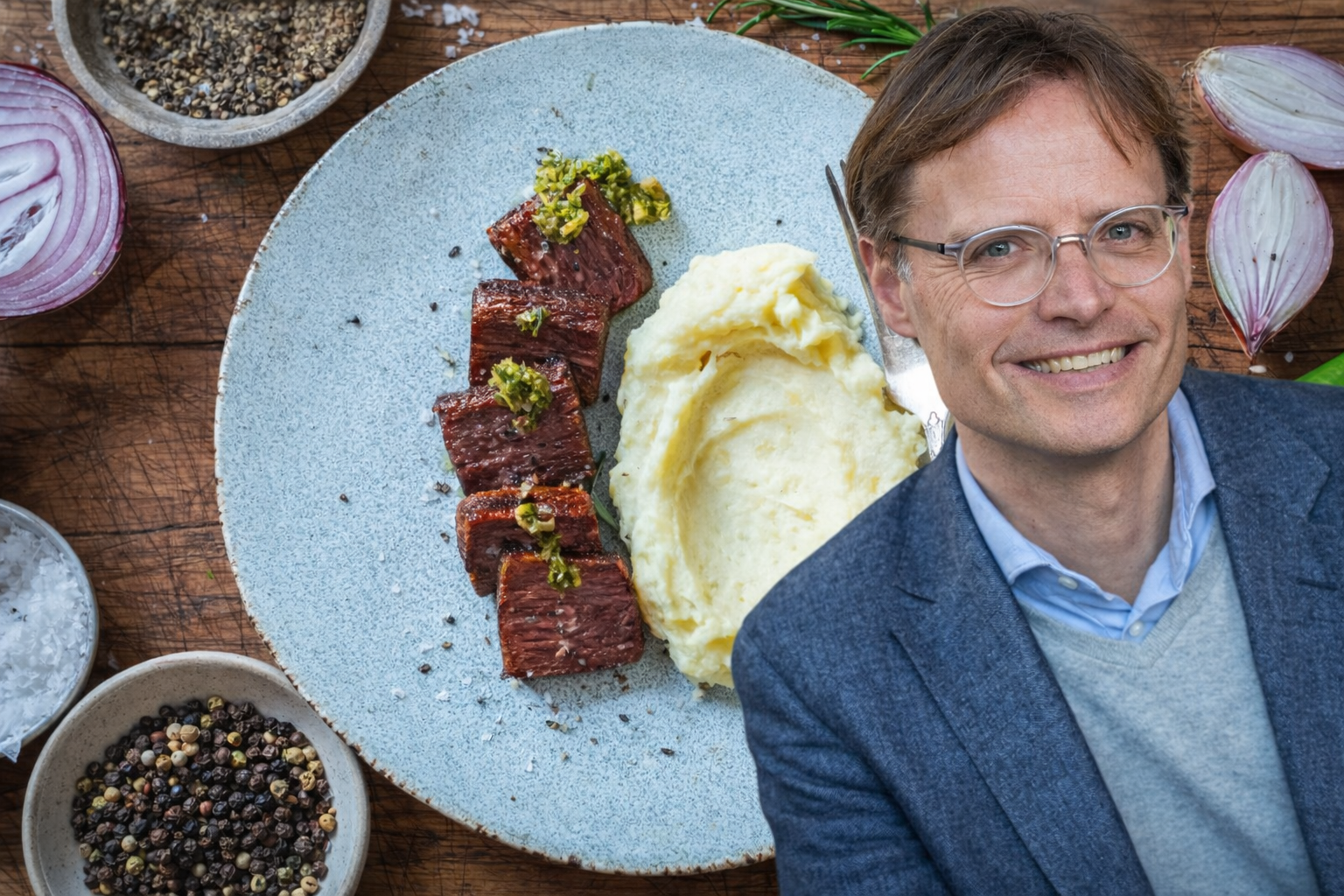
For Edwin Bark, the problem with much of the plant-based category has never been ambition. It’s been execution.

Too many brands, he suggests, rushed to market on the strength of hype, novelty and sustainability messaging, only to forget the one thing that really matters when a product lands on a dinner plate is whether people actually want to eat it again.

That belief sits at the heart of Redefine Meat, the food-tech business aiming to drag meat alternatives out of their worthy, often underwhelming phase and into something far more commercially powerful, a category capable of tempting committed carnivores.

“We need to bring the carnivores into our world not by saying, ‘Stop eating meat,’ but actually by inviting them to try and experience a very good piece of meat that is no longer a compromise,” Bark says.

The company, founded in 2018, has built its name on premium plant-based products engineered to replicate the flavour, texture, scent and cooking performance of animal meat. Its hero products are whole-muscle cuts, designed to do something the category has often struggled with. That is recreating the sensory complexity of a proper steak.

According to Bark, the company’s starting point wasn’t the vegan or vegetarian shopper, but the meat lover.

“What sets us apart from the competition is that we are very meaty. We’re obsessed by meat,” he says. “We have meat scientists working in our R&D team that analyse, on a molecular level, the composition of meat, and what we do is try to find plant-based equivalent molecules to the ones found in animal meat.”

It’s exactly the sort of language that makes Redefine Meat stand out in a market that has often leaned heavily on ethics, greenery and clean-label cues. Bark is clear that, for all the moral and environmental urgency surrounding the food system, consumers are rarely won over by guilt alone. They are won over by habit, pleasure, familiarity and trust.

That’s why the business has gone deliberately in a different direction, from its branding to its product development. “Our brand language is also very premium-meat in look and feel,” he says.

“It’s black and red, and the product is really the hero. Most brands have prepared dishes on the pack. We really give the hero position to our product.”

That thinking extends to the entire architecture of the range. Bark describes it in blunt commercial terms. Some products exist to “play to participate”, while others are designed to “play to win”.

“Play to win is where we have a unique proposition, like our whole cuts,” he says. “Play to participate is the category entry points. Burger patties, mince and so on. Our steak, our whole-muscle cuts, that’s our hero.”

It’s also where Redefine Meat has done much of its brand-building work. While plenty of plant-based players have aimed to mimic burgers, nuggets and sausages, Redefine Meat set its sights higher, both technically and culturally.

If meat still carries premium associations, then steak remains one of the clearest examples of that status. Recreating it was always going to be difficult. That, Bark suggests, was precisely the point.

“When we started the company, we thought, what’s missing in this market? And what makes people crave meat? We concluded that it’s whole-muscle cuts. It’s steak,” he says.

“With our technology background, we said, by using additive manufacturing technology, we should be able to recreate a fully plant-based version of a steak. That became our hero technology.”

Bark is careful about how he describes that technology. Redefine Meat has often been associated with 3D printing, but he prefers a more industrial framing.

“The more precise descriptor is additive manufacturing,” he says. “When you say printing, people think it’s really coming out of nozzles. At the very beginning of our technology development, that was indeed the case. We built what we called the Angus printer. But that specific technology was not scalable.”

From there, the business evolved the concept into something commercially viable. A production line capable of layering plant-based ingredients in a way that mimics the fibrous complexity of meat. It’s this combination of food science and process engineering that Bark sees as Redefine Meat’s real moat.

“We are the first, and I think the only ones, to be able to produce that at scale and also efficiently,” he says. “We have an industrial line of layered production that allows us to mimic the very complex texture of meat.”

That technical confidence is matched by a consumer-facing realism. Bark knows all too well that the category’s growth story has cooled in recent years. Plant-based meat, after a period of explosive momentum, has stalled. Brands have collapsed. Retailers have rationalised ranges. Investors have become more cautious. The initial euphoria has worn off.

But Bark sees that slowdown not as a sign of failure, but as a familiar phase in the adoption curve.

“What we are seeing is just the normal evolution of the S-curve of adoption,” he says. “People have discovered a lot of innovation, they’ve tried it, some are happy with it, some are disappointed. Those that are disappointed with the quality will stay away until there’s a new wave of innovation or an improvement in quality that makes them come back.”

In other words, the category hasn’t diminished. It’s simply reached the point where novelty is no longer enough.

“The truth is, it’s only the very beginning,” he says. “We’ve had the very end of the stagnation phase, and we’re now heading for a new wave of innovation. Not necessarily super disruptive. It’s very much focused on continuous improvement of existing products.”

Bark believes the next phase of growth will be won not by whichever brand can shout loudest, but by whichever brand can deliver the strongest repeat purchase. This is where he thinks Redefine Meat has pulled ahead.

“If the product is good, consumers will buy you,” he says. “We’re growing because we see continuous growth of our repeat purchase, meaning that consumers who try our products for the first time actually come back because they enjoy the product.”

That point is central to his critique of the wider category, and particularly to the race to the bottom that has defined some private-label plant-based ranges.

“Some retailers think you just have to make it cheap and people will buy it,” he says. “People buy it once because it’s cheap, but not a second time if it’s not tasty. The pressure to create very cheap protein means savings are made on the quality of the protein source or on the aromas.

“When you see a cheap burger for one and a half pounds, you can be sure it’s not tasty. It doesn’t exist.”

For Bark, then, the commercial logic is inseparable from the culinary one. Redefine Meat isn’t trying to undercut the market; it’s trying to out-perform it. The company isn’t the cheapest player in the space, he says, and nor does it want to be.

“We’re not the cheapest brand, actually,” he says. “We’re not super premium, but we’re on the above-average price level. Consumers are willing to pay for that because they enjoy the product.”

That confidence has also been built through foodservice, where Redefine Meat has arguably made some of its smartest moves. Before pushing into retail, the business focused on getting its products into restaurants, hotel groups and professional kitchens, using chefs as both validators and development partners.

“From day one, we started working with Michelin chefs,” Bark says.

“Michelin chefs are the most critical, as you can imagine. They would never risk their Michelin status by putting products on the menu that are not Michelin level. That’s why it’s really in our DNA to listen to chefs, but also to listen to consumers and understand their feedback.”

It’s a clever strategy. High-end foodservice gives the brand credibility, but it also gives it proof points. Bark says Redefine Meat now has around 7,000 foodservice locations where its products are on the menu.

When the company did move into retail, Bark says it didn’t want to “buy distribution” through brute-force spending. It wanted to earn it.

“We sit down with retailers that truly believe in our vision and share the ambition to drive this protein transition,” he says. “We create a coalition of the willing.”

That approach helps explain Redefine Meat’s partnership strategy in the UK, including its early work with Ocado and subsequent push into stores with Asda. Online, in particular, gave the brand a valuable testing ground.

“The beauty of working with an online retailer is that you get a lot of data, so you can constantly test and learn and improve your performance,” he says. “Once you have that collaboration where you can be totally transparent on how you do things and how you can improve them, there is a fantastic highway to growth.”

For all the confidence Bark has in the company’s model, he’s under no illusion about the headwinds facing the category. He speaks with visible frustration about regulatory efforts to limit the use of traditional meat terminology on plant-based products, dismissing the logic behind such measures as disconnected from consumer reality.

“I’ve sold literally millions of consumer packs. I never had any complaint from a consumer saying, ‘Hang on, your product is not made of animals, it’s plant-based, how can it be?’” he says. “There is no confusion.”

He sees that debate as a distraction from the real work required to shift diets at scale, particularly at a time when climate pressures, supply chain strain and rising livestock costs are likely to reshape meat consumption anyway.

“Consumers ultimately have to accept that meat becomes as exclusive as it was fifty years ago,” he says. “We used to consume meat only two or three times a week. We probably have to go back to that old normal.”

That is where Bark believes plant-based alternatives, if done well enough, have a major opening. Not as a fringe ethical purchase, nor as a synthetic substitute that consumers reluctantly tolerate, but as a mainstream, desirable protein choice.

“The issue is urgent,” he says. “We can’t wait another generation to achieve this shift. We have to be as attractive as possible to the largest possible group of consumers.”

That brings the story back to the same simple tension Redefine Meat appears determined to resolve: how to create products that satisfy the emotional and sensory pull of meat without inheriting the environmental cost of the livestock system.

Bark talks about this not as a branding exercise, but as a long-term engineering challenge.

“Ultimately, we will be able to beat the cow,” he says. “Because the cow is not innovating. We are.”

It’s a bold line, but then boldness is part of what makes Redefine Meat interesting. This isn’t a company asking for patience, pity or ideological buy-in. It’s asking to be judged on taste, texture, consistency and performance. The same standards traditional meat has long taken for granted.

And perhaps that is the most telling thing about Bark’s vision for the category. He doesn’t talk like a man trying to defend plant-based food from sceptics. He talks like someone who believes the next generation of meat is already being built and the future leaders of the category will be those who make consumers forget the compromise ever existed.

“People that tried poor products and were disappointed stay away for at least a year,” he says. “That’s why quality matters so much. Once consumers buy into ever-better products, the repeat purchase will be there.”

For Redefine Meat, that is the whole game. Not just getting on the plate, but getting invited back.

Sign up here to get the latest grocery and food news each morning

FeaturesFMCGResearchSupermarkets

Social

SUBSCRIBE TO OUR DAILY NEWSLETTER

  • This field is for validation purposes and should be left unchanged.

Most Read

Most Read

FeaturesFMCGResearchSupermarkets

Leave a Reply

Your email address will not be published. Required fields are marked *

Fill out this field
Fill out this field
Please enter a valid email address.

RELATED STORIES

Latest Feature

Menu

Please enter the verification code sent to your email: