Grocery retail is revealing a bigger challenge for Generative AI
David Gottlieb, chief revenue officer at FORM, details the key lessons from grocery and CPG operations on turning AI insight into real-world action.
Grocery retail is one of the most unforgiving businesses in the world.
Global food and grocery is projected to grow at a compound annual growth rate of roughly 6.7 percent through 2034, but net profit margins for supermarkets remain razor-thin.
And consumers, still price-sensitive after years of food inflation, are quicker than ever to walk out empty-handed. In the UK, shoppers are now paying more and taking home less: according to Savills, grocery volumes fell 1.3% on a rolling twelve-month basis even as values grew 0.8%.
To protect margins, which continue to be under pressure from rising labour and logistics costs, the industry is turning toward technology, especially artificial intelligence, to drive efficiency.
Computer vision—a proven advantage at retail
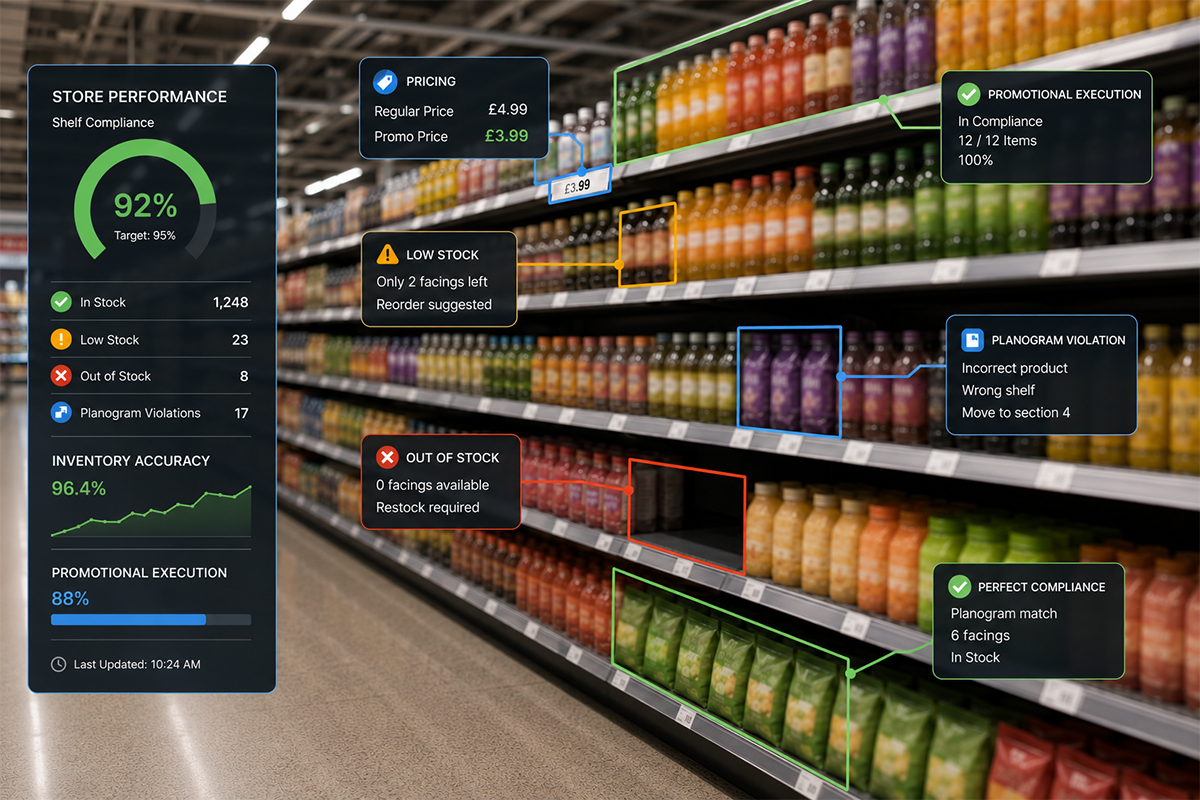
Computer vision (CV) has largely solved the recognition problem at the shelf for grocery retailers and CPG brands. Given a clear image of a grocery aisle, today’s recognition engines can identify SKUs, flag planogram violations (products misplaced on the shelf), and detect out-of-stock conditions with a level of accuracy that would have seemed remarkable just five years ago.
And yet stock-outs persist, and promotional displays still go up late, or not at all.
There are myriad reasons. Retailers’ perpetual inventory data is often wrong, and many products are merchandised in more than one location simultaneously. This creates a disconnect between what systems believe is in stock and what’s actually available to the shopper.
Knowing the store has inventory and knowing whether those locations are properly executed, however, are two different issues.
The mainstream adoption of large language models (LLMs) has prompted a reasonable response across the retail landscape: take the shelf data, feed it to an LLM, and let the model figure out what to do next.
But this approach ignores the fundamental problem of applying unconstrained models to retail problems. General-purpose models aren’t trained on the specific, granular data that makes retail execution decisions trustworthy. A model operating at 80 percent confidence might be acceptable in the context of customer service, but it’s a liability when working on critical retail issues.
How computer vision works at retail
Effective retail execution requires a supervised machine-learning process built specifically for the grocery aisle. The system needs to know what the shelf is supposed to look like: which products go where, in what quantity, and at which location.
Then it needs to recognize what’s actually on the shelf. CV can do this with a high level of accuracy, because it’s been trained on millions of images across varying lighting conditions, orientations, and levels of obstruction.
Next, for each SKU, the system asks things like: Is this the correct number of facings? Are they in the right location? Are they present at all? The model also flags so-called intruders—products that are on the shelf but aren’t supposed to be there.
Historically, the value locked inside CV data like this has been delayed by a significant reporting lag. Visual data was captured, processed, and deposited into a central repository, where its utility depended on the quality of business intelligence (BI) reports.
This is where an LLM can add genuine value: The model acts as a synthesis engine for different data streams and helps interpret what the data is telling you. A beverage manufacturer wanting to know which zero-alcohol SKUs are gaining share in specific regions, for example, could use an analyst to parse a BI platform. But an LLM trained on trusted shelf data can deliver those insights in seconds.
Subscribe to Grocery Gazette for free
Sign up here to get the latest grocery and food news each morning
Closing the gap between CV and LLMs
The economics of purpose-built AI are straightforward, and customers have largely voted with their wallets. CV at retail essentially does one thing really well, and does it at scale.
The calculus becomes more difficult when the tools are broader and more open-ended. Generative AI is often priced by tokens, so each prompt and response consumes measurable usage. Scaled across hundreds of thousands of store associates making queries throughout the day, those costs escalate quickly.
The question for retailers today is whether it makes sense to invest in these tools. One area where the value is already clear is intraday replenishment. Today, many store associates rely on a manual and labor-intensive approach: They walk the aisles, note where products are missing, and then check the stockroom to pull what’s needed for replenishment.
The system works, mostly. But a machine-led system can generate a ranked list of what to focus on, weighted by basket size and gross margin impact, updated in real time—and the data to build a model like this already exists in most retail environments today.
Outside of proven CV applications, however, the killer apps for generative AI in retail aren’t yet obvious. If you look five years into the future, there will almost certainly be use cases that every retailer looks back on and says, Yes, of course we’re doing that, the payoff is clear.
But today, the companies best leveraging AI aren’t replacing fundamental retail execution with LLMs. The real value comes in applying purpose-built AI in the right places, with the right data, and the right constraints—and letting the technology do what it does well.
David Gottlieb has over 20 years of experience helping brands navigate labour, cost, and supply chain challenges through data-driven and AI-enabled solutions.